PRIM.The operational layerfor race officiating.
Four consoles sharing one shared record. Built for the people who run race weekends.
- Rotating officiating panels
- Race directors and technical delegates
- Multi-event championship seasons
- Teams under regulation
The shared layer
for the work itself.
PRIM is built so stewards can issue decisions, race directors can track session state, and technical delegates can manage scrutineering, components, and parc fermé in one place. Actions are checked against the regulation as they happen, and the record builds from the work itself.
Before the call.
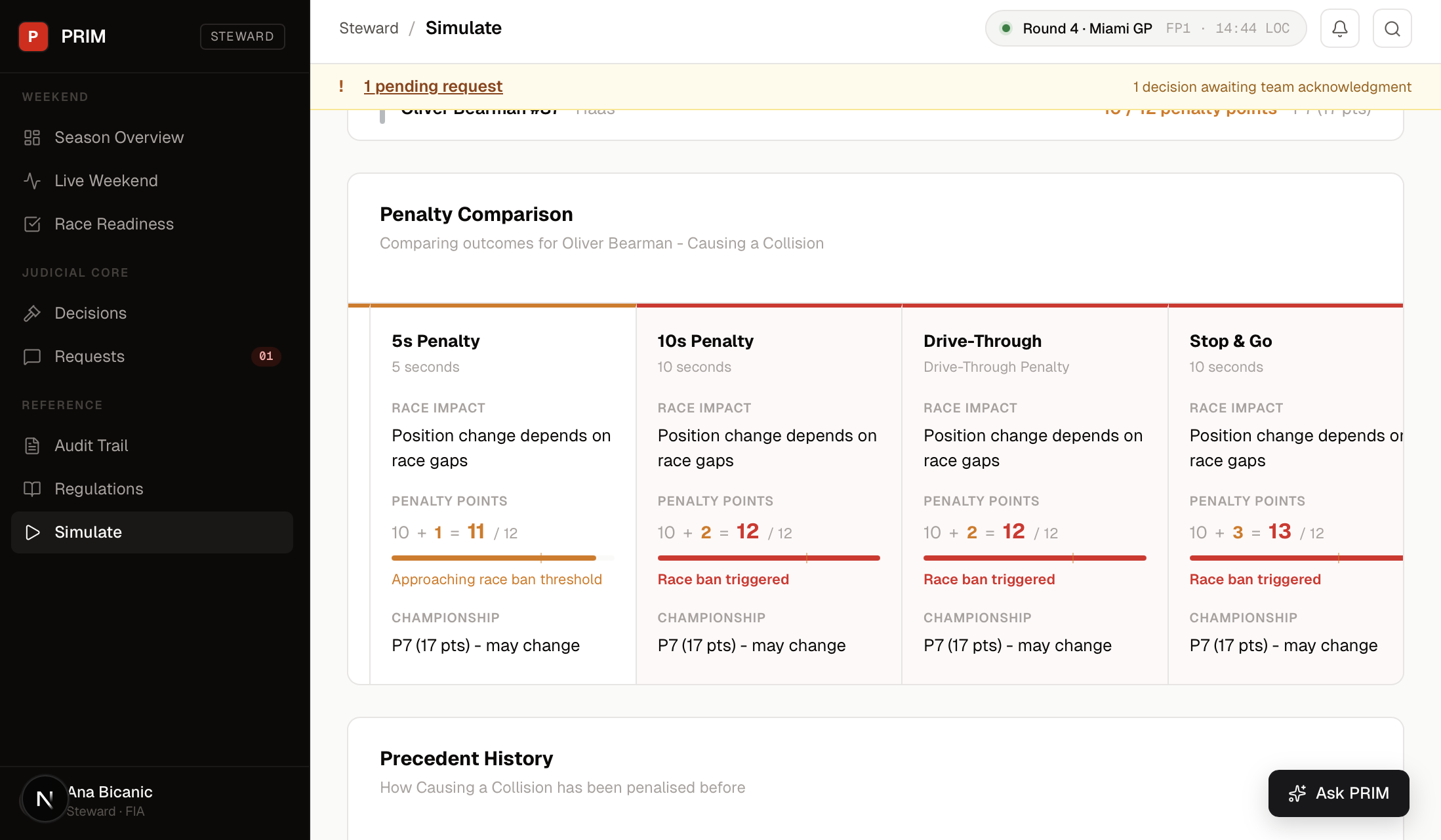
Every outcome, compared.
Pick a driver, pick an infringement. PRIM runs every plausible penalty side by side, with race impact, penalty-point math, and race-ban warnings. Nothing gets committed.
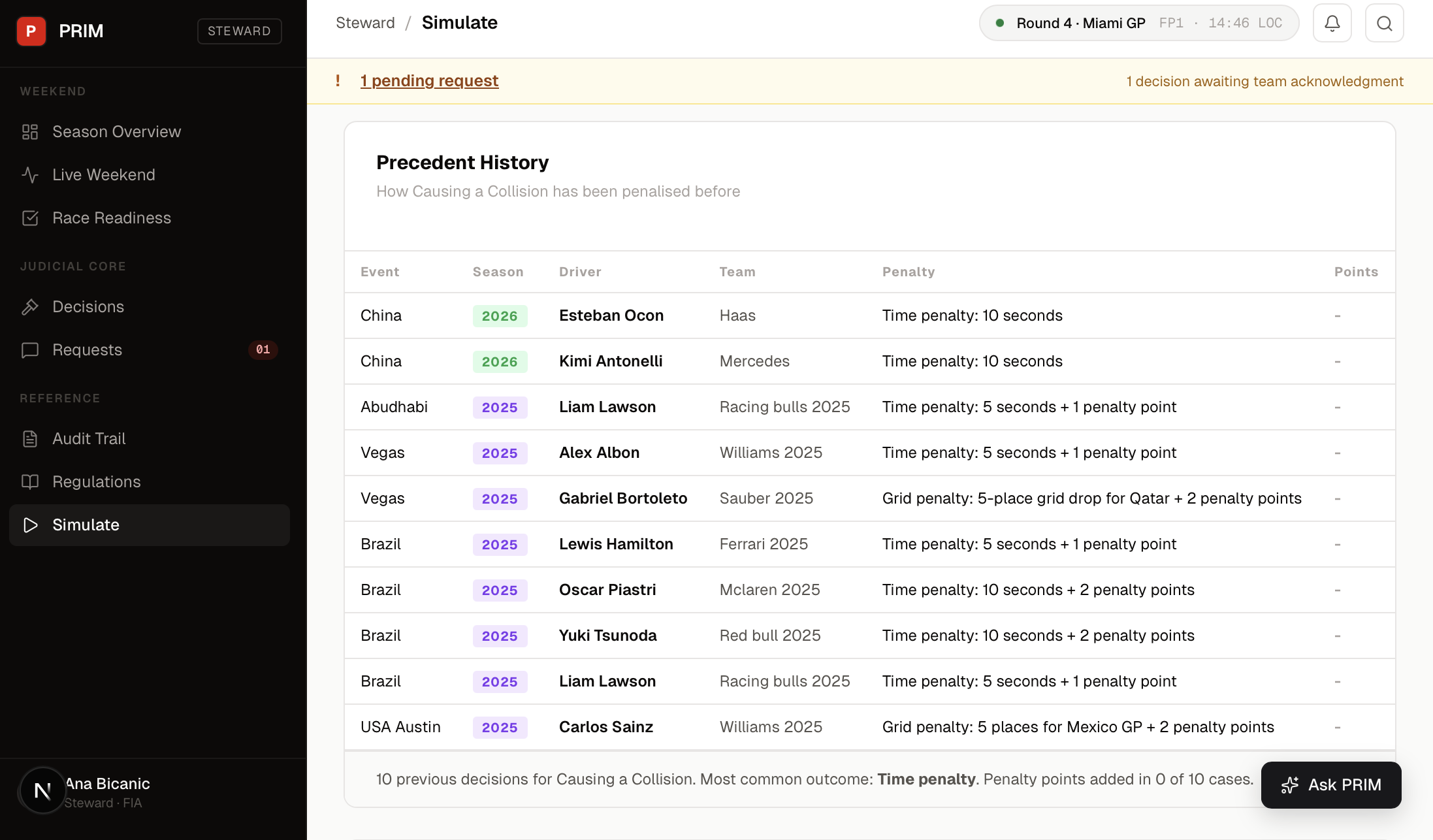
Ten prior decisions for the same infringement. Two seasons of context. Consistency visible before the call.
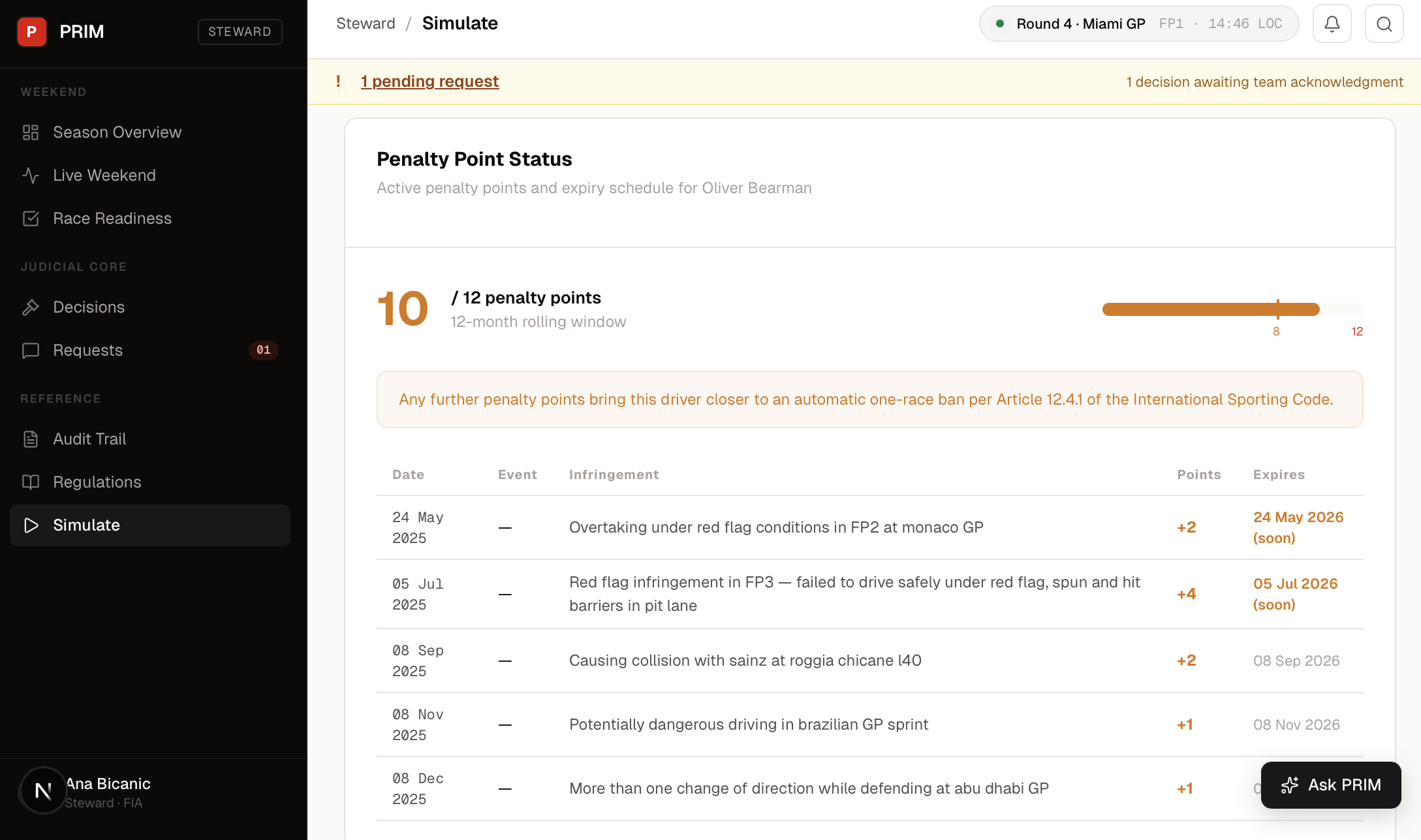
Penalty points tracked per driver across a rolling window. The race-ban threshold visible at every step.
Operational state,
gate to flag.
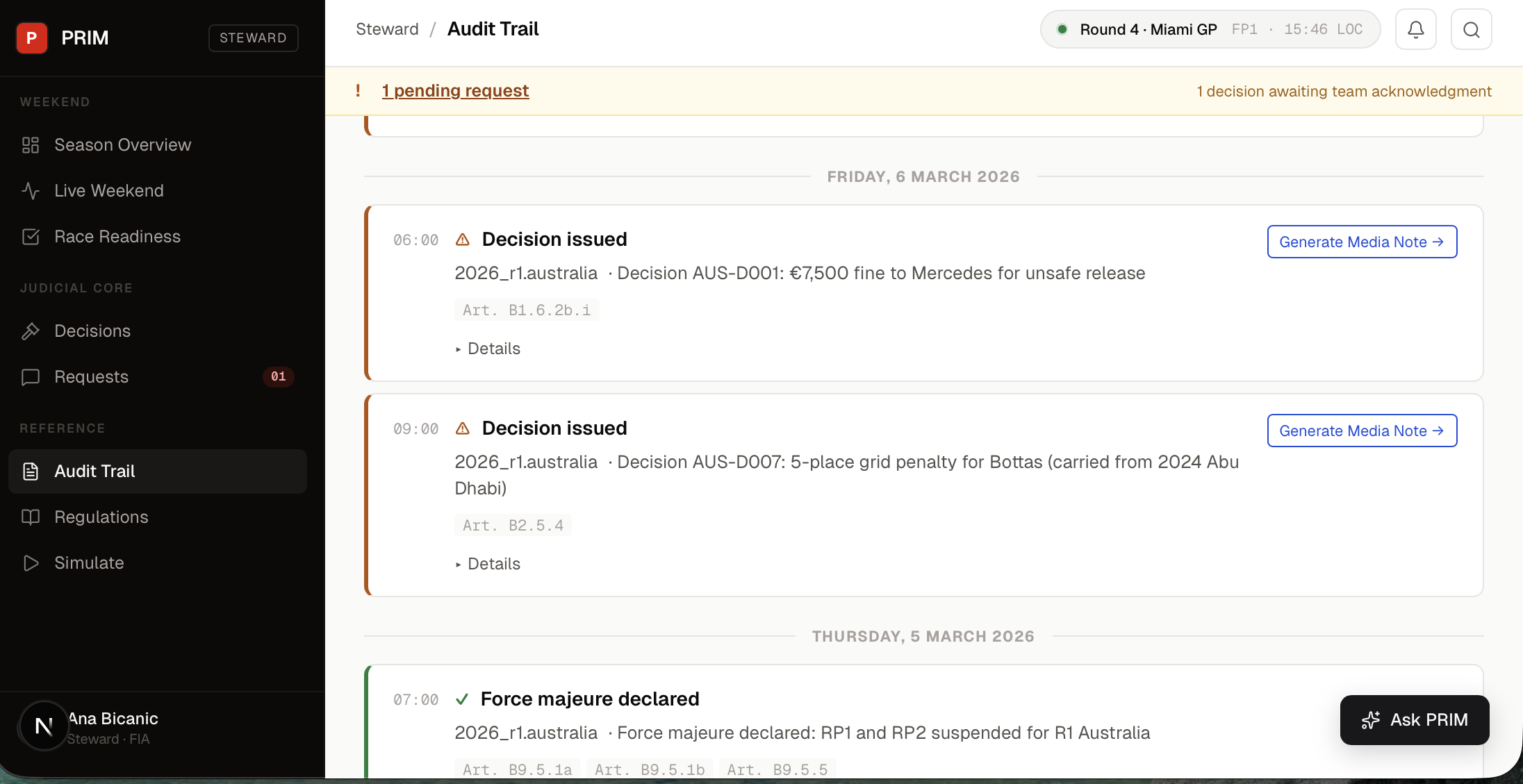
The operational checks a race weekend runs through, captured as they happen. Timestamped, sourced, and reconstructable from any point.
One incident.
Every check it passes through
before a ruling exists.
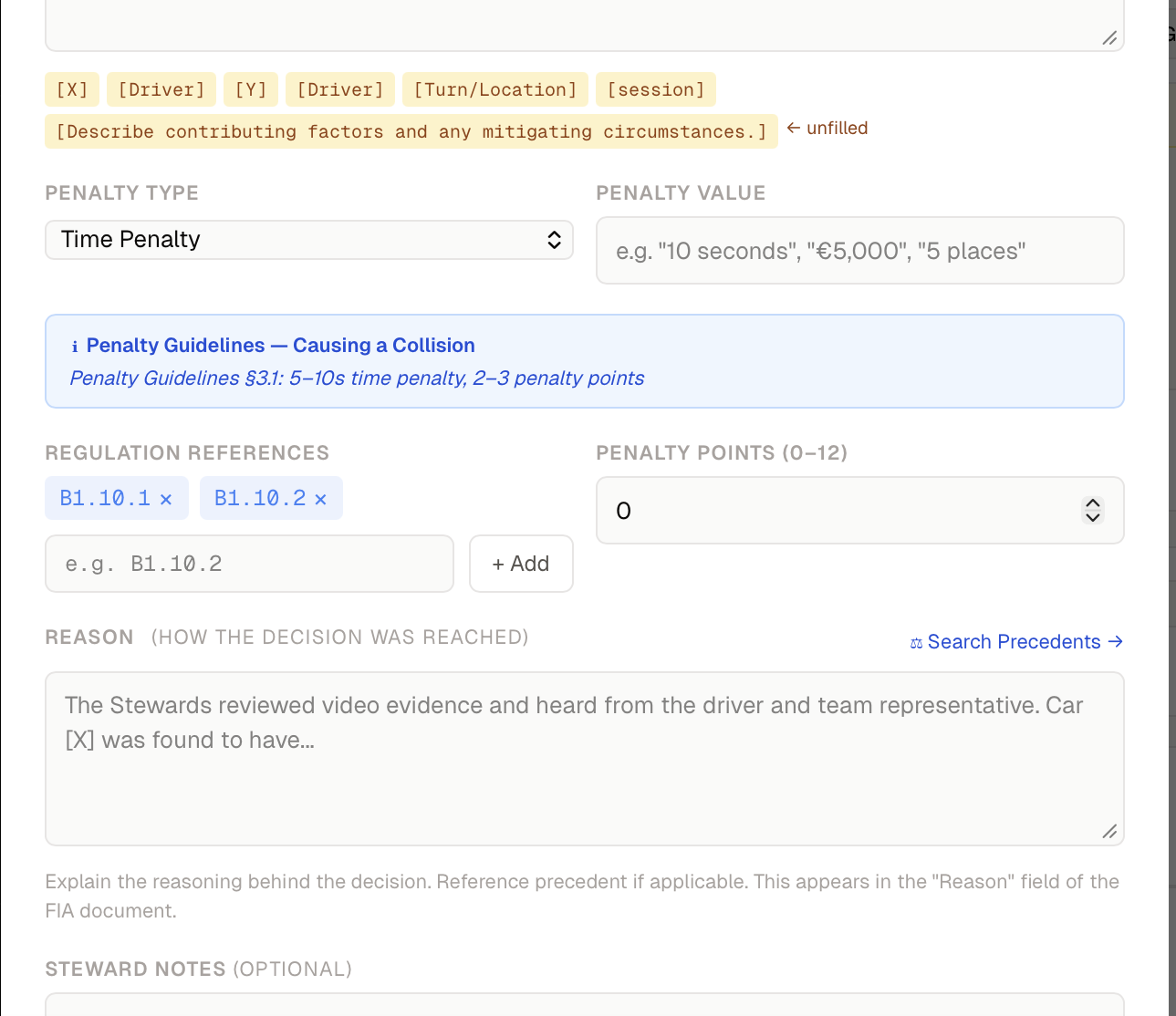
Collision at the hairpin. Four checks in thirteen minutes. The precedent chain, the penalty math, the formal FIA output.
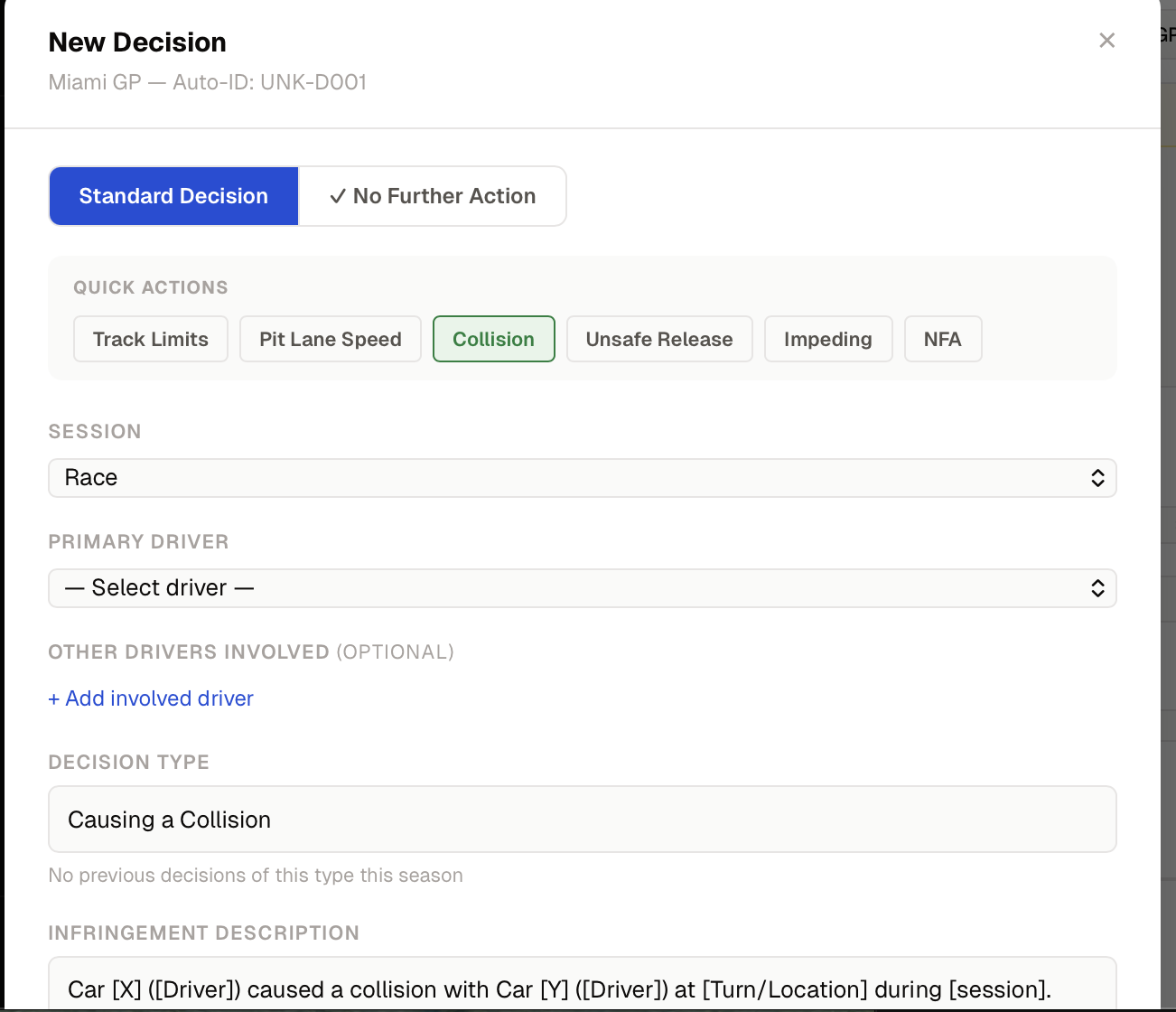
A steward opens a decision.
Quick actions for the common infringements: Track Limits, Pit Lane Speed, Collision, Unsafe Release. Selecting Collision starts a draft with the primary driver ready to attach.
Article-backed at entry.
Penalty type, regulation references, and penalty guidelines surface for the exact infringement. The reason field connects to precedent search.
Every source the call drew on, logged.
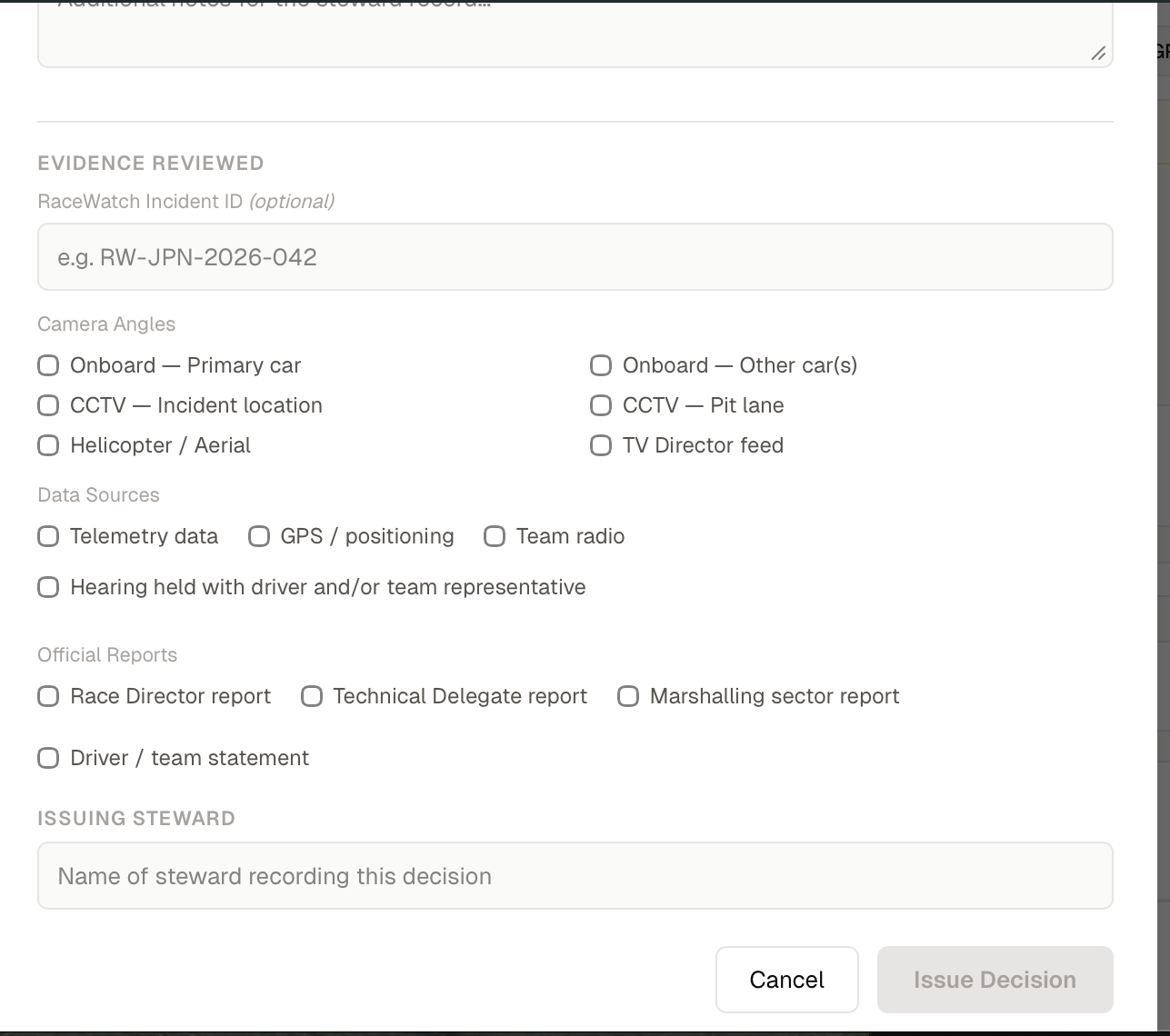
Camera angles, telemetry, GPS, team radio, official reports. The evidence reviewed becomes part of the record. Issuing steward stamped.
A formal FIA document, generated.
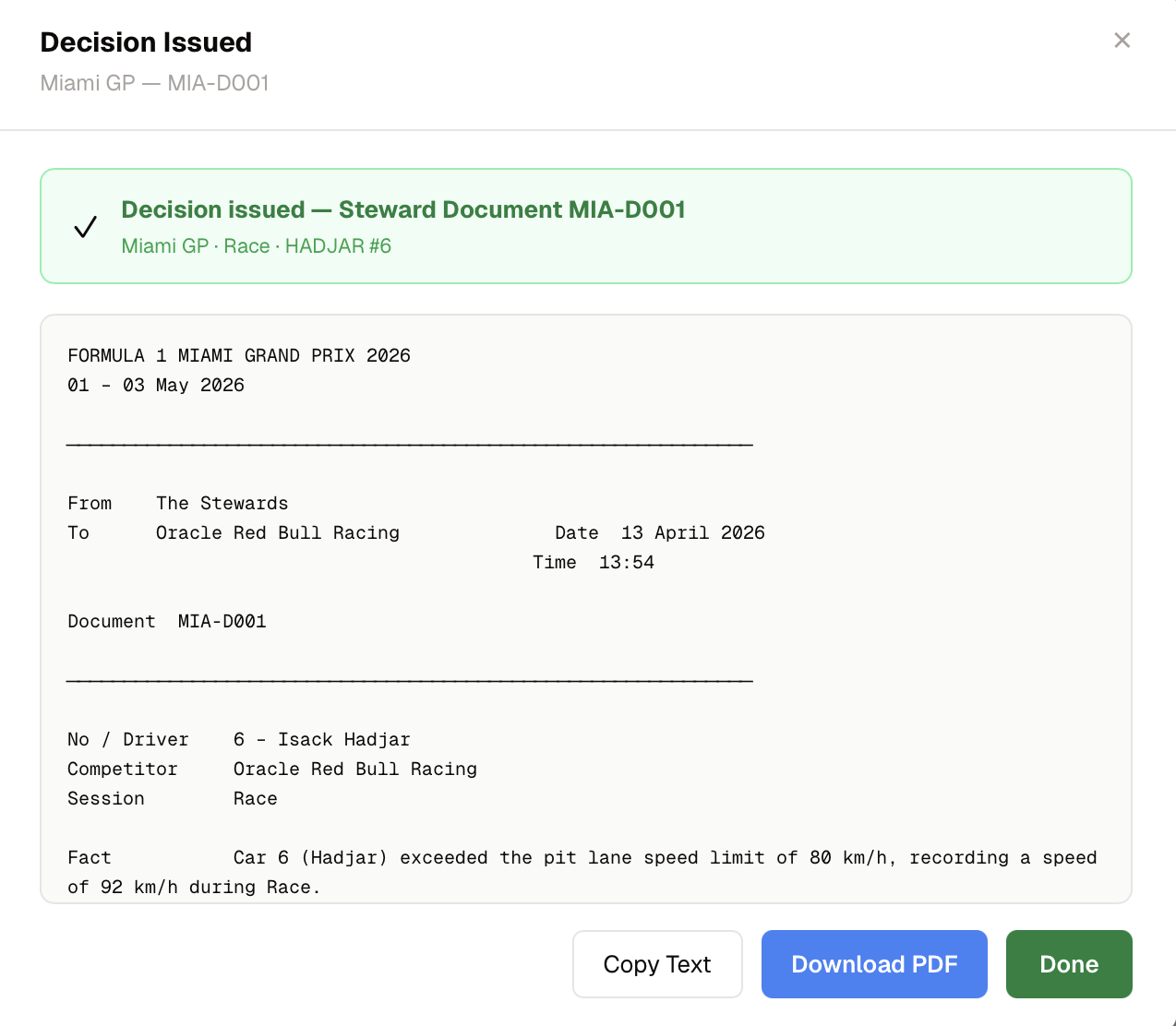
Document MIA-D001 produced in the layout the paddock recognises, ready to send. Fact, article, and penalty stored beneath the surface as structured data.
One record.
Different artifacts.
PRIM holds structured data behind decisions, component changes, and parc fermé observations. Official artifacts can be generated from that record on demand, in the layouts the paddock recognises.
- ◆Decision documents · FIA layout, signed and numbered
- ◆Media notes · Generated from any decision in the audit trail
- ◆Technical reports · Pre-event, parc fermé, post-race
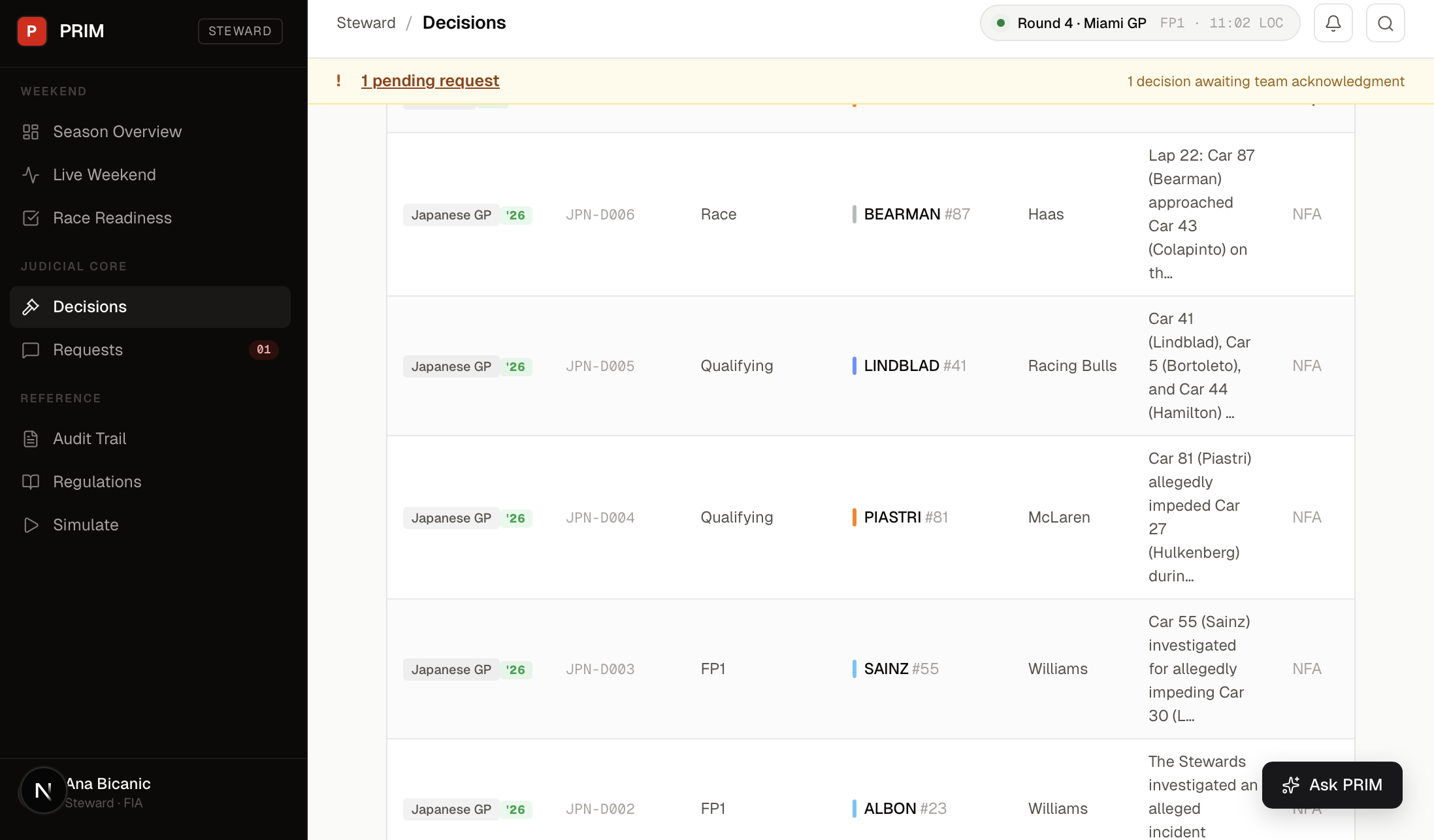
- ◆Audit trail · Every state transition, timestamped
Acknowledge.
Or petition.
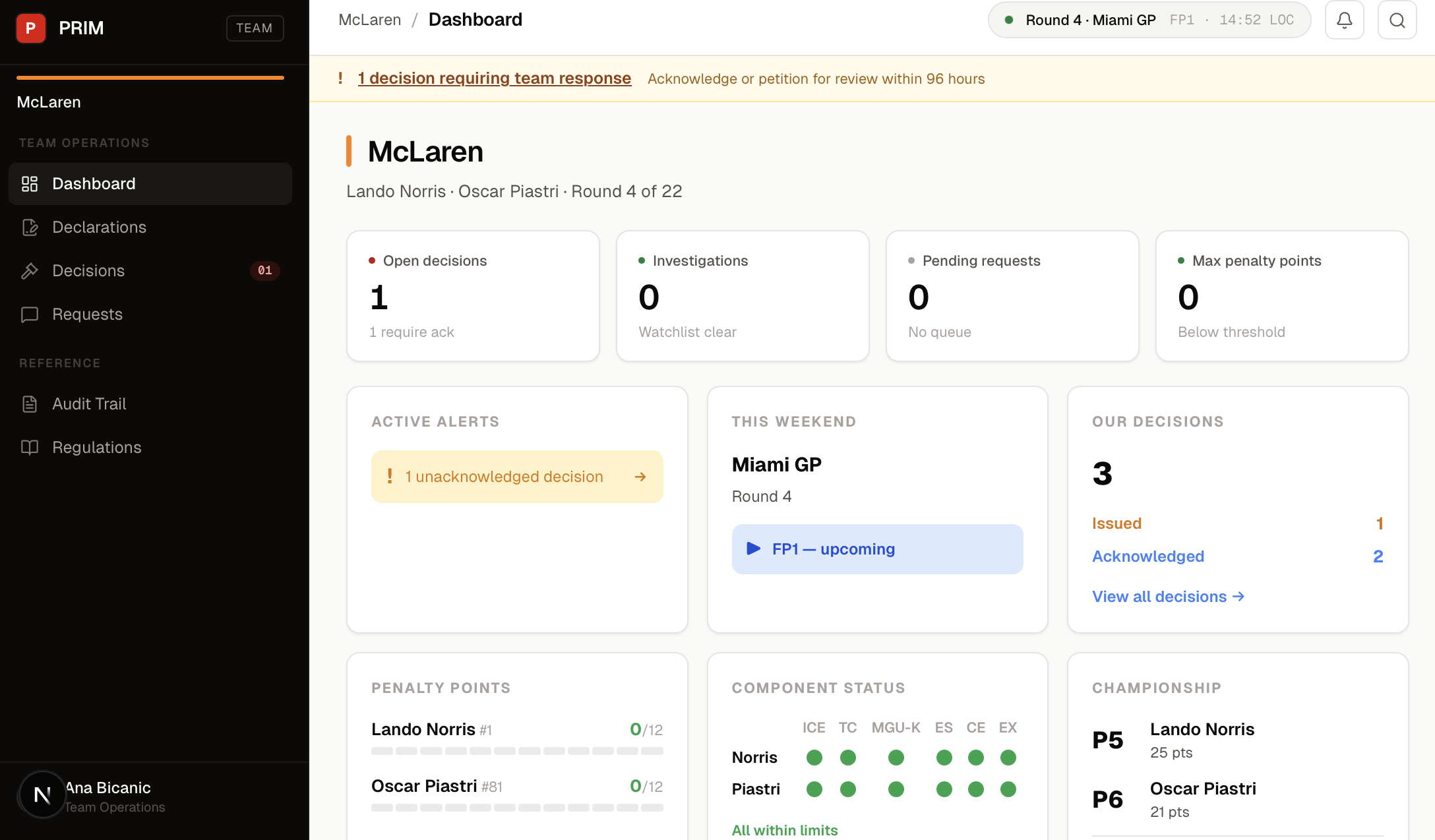
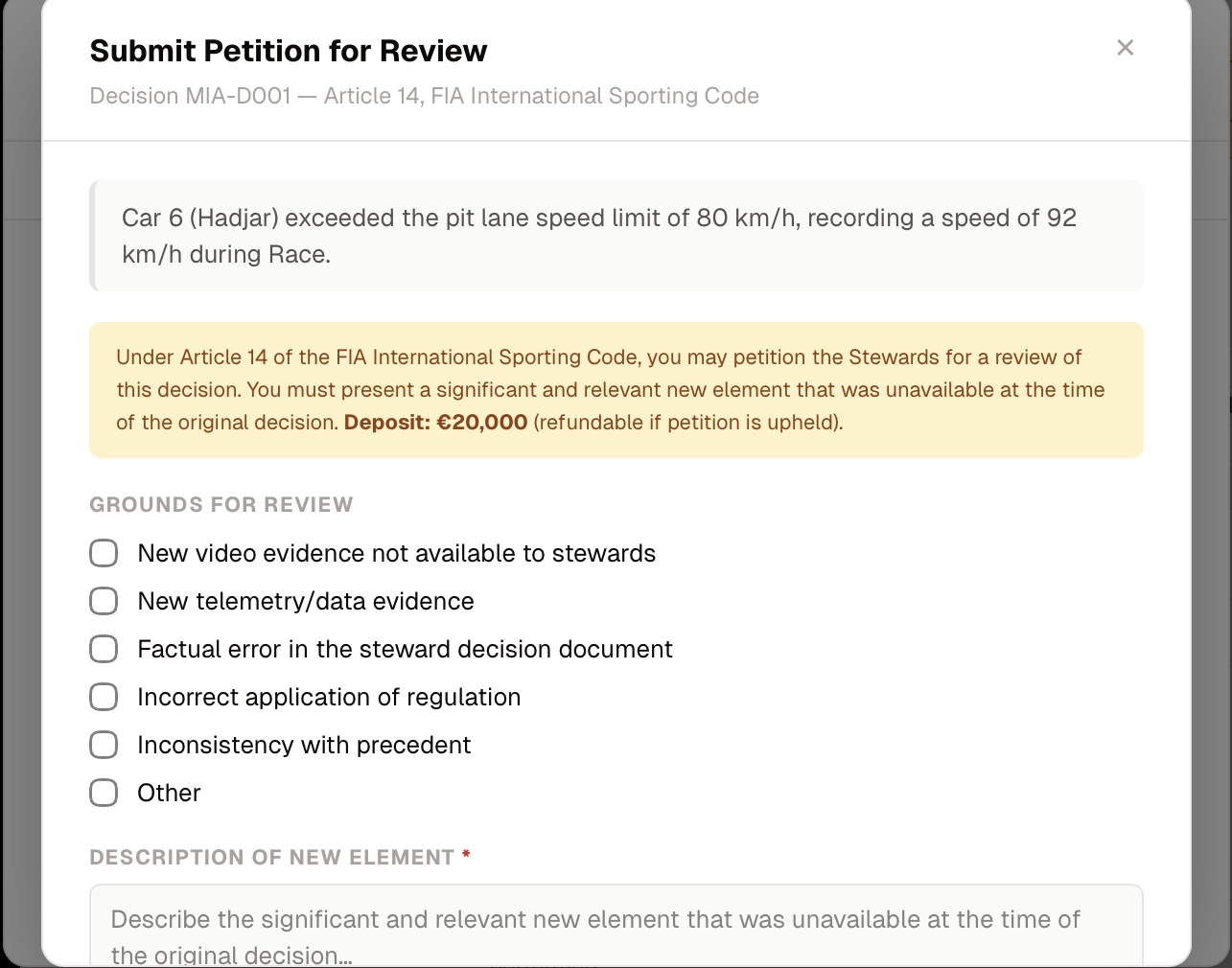
The decision appears in the team’s dashboard with a 96-hour countdown to respond. Acknowledge and move on, or open a structured dispute under Article 14 with grounds for review, new evidence, and a refundable deposit.
Ask PRIM.
Grounded in your data.
A regulatory intelligence assistant on every console. Answers are drawn from PRIM’s database with citations back to the source decisions. If the answer is not there, the assistant says so.
Your data.
Your boundary.
Three layers of access, mapped to how the FIA already operates: public artifacts everyone reads, team-private data each team owns, and an audit layer the FIA can inquire into when needed.
A constraint engine.
The regulation,
executable.
PRIM is built as a deterministic runtime with thin clients on top. Rulings, state transitions, and repair paths are structured and reconstructable, so the reasoning stays consistent across panels.
Currently
in development.
PRIM is not yet deployed at any federation. We are talking with people who run race weekends about what comes next, and looking for the right partner to start with.